
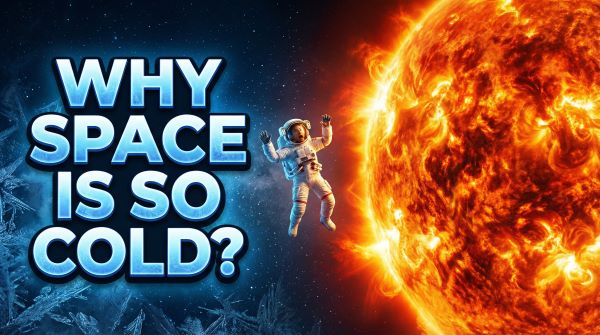
Why Space Is So Cold Even Near the Sun
Have you ever wondered why space is so cold even near the Sun?
It sounds confusing at first. The Sun is incredibly hot—its core reaches around 27 million degrees Fahrenheit. So logically, space around it should be extremely hot too… right?
Surprisingly, that’s not true.
In fact, space is one of the coldest places in the universe, with temperatures close to absolute zero. This blog will explain the science behind this mystery in a simple and beginner-friendly way.
☀️ How Hot Is the Sun Actually?


The Sun is a massive ball of burning plasma. Its temperature varies depending on the layer:
- Core: ~27 million °F
- Surface: ~10,000 °F
- Corona (outer layer): Millions of degrees
It releases an unimaginable amount of energy every second.
👉 So why doesn’t this heat warm up space?
To understand that, we need to learn what temperature really means.
🌡️ What Is Temperature? (Simple Explanation)
Temperature is not just about how hot or cold something feels.
👉 It is the measure of how fast particles are moving.
- Fast-moving particles = High temperature
- Slow-moving particles = Low temperature
Now here’s the key idea:
👉 No particles = No temperature
And space?
It is almost completely empty.
🌌 How Empty Is Space Really?


Space might look full of stars, but most of it is empty.
- In space: ~1 atom per cubic meter
- On Earth: ~25 quintillion molecules per cubic meter
That’s a massive difference!
Because of this, space cannot hold heat like Earth does.
🔥 How Heat Travels in Space
To fully understand why space is cold near the Sun, we need to look at how heat moves.
🔹 1. Conduction
- Heat transfer through direct contact
- Example: Touching a hot pan
👉 Not possible in space (no contact)
🔹 2. Convection
- Heat transfer through fluids (air or water)
- Example: Boiling water
👉 Not possible in space (no air)
🔹 3. Radiation
- Heat transfer through electromagnetic waves
- Example: Sunlight reaching Earth
👉 This is the only way heat travels in space
⚡ The Most Important Point
👉 Radiation does NOT heat empty space.
👉 It only heats objects it hits.
This is the main reason behind:
❄️ Why Space Is So Cold Even Near the Sun
The Sun is constantly sending energy in all directions.
But space does not absorb that energy.
Instead:
- Energy travels through space
- It only heats planets, objects, or astronauts
- Empty space remains cold
🌗 Extreme Temperatures in Space


Space creates extreme temperature differences:
- Sunlit side: Up to +250°F
- Shadow side: Down to -250°F
👉 Just a few feet apart!
This happens because:
- No atmosphere to spread heat
- No air to balance temperature
🌕 Real Example: The Moon
The Moon clearly shows this effect:
- Daytime: Very hot
- Nighttime: Extremely cold
Why?
👉 Because it has no atmosphere to trap heat.
🛰️ Spacecraft and Temperature Control
Spacecraft face a serious challenge:
- Overheating in sunlight
- Freezing in shadow
That’s why engineers design:
- Heat shields
- Cooling systems
- Thermal insulation
📡 The Background Temperature of the Universe


Even though space is empty, it has a baseline temperature.
This comes from the cosmic microwave background—radiation left from the Big Bang.
👉 Temperature: -455°F
This is the natural temperature of the universe.
🌍 Why Earth Is Different
Earth is not like space.
👉 It has an atmosphere.
This atmosphere:
- Traps heat
- Distributes warmth
- Protects life
Without it:
- Days would be extremely hot
- Nights would be freezing cold
Just like the Moon.
🔥 Mercury vs Venus: A Surprising Fact
| Planet | Distance from Sun | Temperature |
|---|---|---|
| Mercury | Closest | Hot days, freezing nights |
| Venus | Farther | Always extremely hot |
👉 Why?
- Mercury: No atmosphere
- Venus: Thick atmosphere traps heat
🧠 Key Takeaways (Quick Summary)
- Space is almost empty
- Temperature depends on particles
- No particles = No heat retention
- Only radiation works in space
- Radiation heats objects, not empty space
👉 That’s why space is freezing cold
🚀 Conclusion
Now you finally understand why space is so cold even near the Sun.
It’s not about distance—it’s about matter and energy transfer.
The universe is mostly cold and empty, with only small pockets of heat like stars and planets.
And Earth?
It’s a rare and perfect place where everything is balanced just right for life.
🔔 Call to Action
If you enjoyed this explanation:
👉 Share this article
👉 Bookmark for later
👉 Follow for more amazing science facts 🚀