
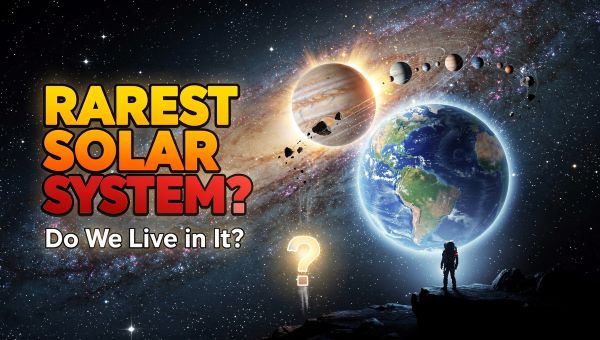
Is Our Solar System Rare in the Universe?
Is our solar system rare in the universe?
This is one of the most fascinating questions in modern science.
When we look at the night sky, we see thousands of stars. But scientists from organizations like NASA estimate that our galaxy alone contains hundreds of billions of stars—and most of them have planets.
So, if planets are so common, why does Earth feel so special?
In this blog, we will explore the science behind our solar system, what makes it unique, and whether we might be living in one of the rarest systems in the universe.
🌍 Structure of Our Solar System


Our solar system has a very organized structure, which is not commonly seen elsewhere.
🪐 Inner and Outer Planets
The solar system is divided into two main regions:
Inner Planets (Rocky):
- Mercury
- Venus
- Earth
- Mars
Outer Planets (Gas Giants):
- Jupiter
- Saturn
- Uranus
- Neptune
Between these two regions lies the asteroid belt, a ring of rocks and debris.
👉 This separation is important because it shows how planets formed in a balanced and stable way.
☀️ The Role of a Stable Sun


Our Sun is a G-type star, often called a “yellow dwarf.”
Why is this important?
- It is stable and long-lasting
- It has been shining for 4.6 billion years
- It produces controlled energy, not extreme radiation
Many stars in the universe are far more violent. According to research from the Harvard-Smithsonian Center for Astrophysics, unstable stars can destroy nearby planets with powerful radiation.
👉 This makes our Sun perfect for supporting life.
🪐 Jupiter: Earth’s Hidden Protector


One of the most important factors in answering “is our solar system rare in the universe” is Jupiter.
🌟 Why Jupiter Matters:
- It has massive gravity
- It can deflect or capture dangerous asteroids
- It protects inner planets like Earth
Studies from NASA Jet Propulsion Laboratory suggest that without Jupiter, Earth would face more frequent and deadly impacts.
👉 In many other planetary systems, this kind of protection does not exist.
🌙 The Moon: A Rare Advantage


Earth’s Moon is unusually large compared to our planet.
🧠 Why is this important?
- It stabilizes Earth’s axis
- Prevents extreme climate changes
- Helps maintain a stable environment for life
Without the Moon, Earth’s tilt would change unpredictably, causing extreme weather and climate instability.
🌡️ The Perfect Distance: Habitable Zone


Earth is located in the habitable zone, also known as the “Goldilocks zone.”
✔️ What does this mean?
- Not too hot
- Not too cold
- Just right for liquid water
Comparison Table 👇
| Planet | Distance from Sun | Condition |
|---|---|---|
| Venus | Too close | Extremely hot |
| Earth | Perfect | Supports life |
| Mars | Too far | Too cold |
👉 Even small changes in distance can make a planet uninhabitable.
🌍 More Than Just Location: Earth’s Special Features
Being in the habitable zone is not enough.
Earth also has:
- 🌐 Magnetic Field – protects from harmful radiation
- 🌋 Plate Tectonics – regulates climate
- 🌫️ Atmosphere – maintains temperature and air
According to the National Science Foundation, these features are critical for long-term life.
🔭 What Have We Discovered So Far?


Since the 1990s, scientists have discovered over 5,000 exoplanets (data from NASA Exoplanet Archive).
🌌 Common Types of Planets:
- Super-Earths (larger than Earth)
- Hot Jupiters (gas giants close to stars)
- Planets with extreme conditions
👉 Most of these systems look very different from ours.
🔥 Why Other Star Systems Are Different
Most stars in the universe are red dwarfs.
Problems with Red Dwarfs:
- Frequent radiation flares
- Planets are too close to survive
- Often tidally locked
Research from the SETI Institute suggests these conditions may not support complex life.
🧪 Rare Earth Hypothesis Explained Simply
The rare earth hypothesis suggests that while simple life may be common, complex life is extremely rare.
🧩 Why?
Because it requires a perfect combination of:
- Stable star
- Right distance
- Protective planets
- Strong magnetic field
- Long-term stability
👉 Missing even one factor can make life impossible.
🌌 So, Is Our Solar System Rare?
Let’s summarize:
- Planets are common
- But Earth-like conditions are rare
- Our solar system has a perfect balance
Some scientists estimate that less than 1% of systems are similar.
👉 That means our solar system might be one of the rarest in the universe.
🧠 Conclusion
So, is our solar system rare in the universe?
👉 The answer is: Most likely, yes.
Earth is not just a lucky planet.
It is the result of billions of years of stability, protection, and perfect conditions.
While we may not be alone, finding another planet exactly like Earth could be extremely difficult.
🌍 And that makes our home… truly special.
📌 Call to Action
If you enjoyed this article, share it with others and explore more space mysteries.
Because the more we learn… the more incredible the universe becomes 🚀