
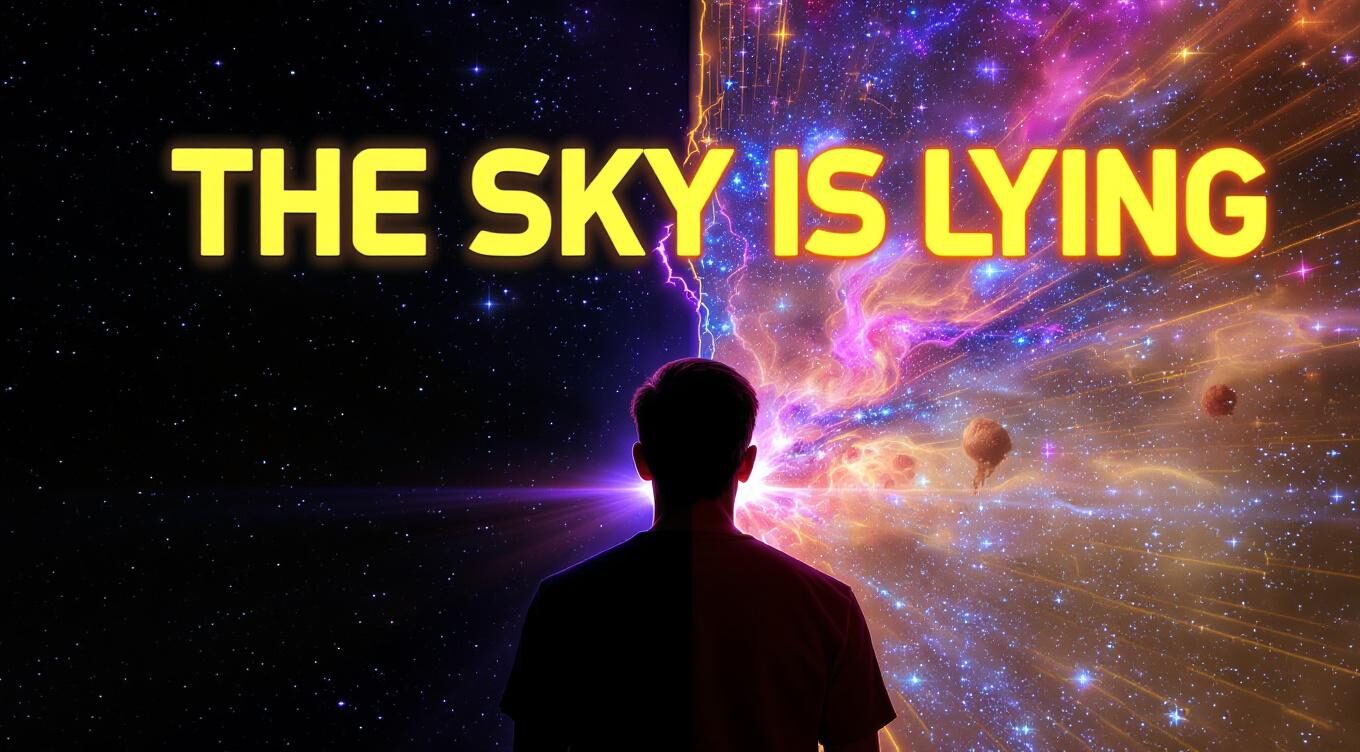
Why Is the Night Sky Dark? Olbers’ Paradox Explained
Have you ever looked up and wondered why is the night sky dark when the universe is full of stars? It seems strange, right? If space is infinite and packed with glowing stars and galaxies, the sky should be bright all the time.
But instead… it’s mostly black.
This mystery confused scientists for over 200 years and is known as Olbers’ Paradox. Today, thanks to modern astronomy, we finally understand the answer—and it completely changes how we see the universe.
In this blog, we’ll break down this fascinating topic in simple terms so anyone can understand it.
🌌 What Is Olbers’ Paradox?


Olbers’ Paradox is a simple but powerful question:
👉 If the universe is infinite and filled with stars, why isn’t the sky bright?
Think about this example:
- Imagine standing in a forest that never ends
- No matter where you look, you eventually see a tree
Now replace trees with stars.
In an infinite universe:
- Every direction should end at a star
- The sky should look like a glowing wall of light
But it doesn’t.
Instead, we see darkness.
🧠 The First Clue: The Universe Has a Beginning
🌟 The Big Bang Changes Everything


The first major breakthrough came from the Big Bang Theory.
Scientists discovered that:
- The universe is about 13.8 billion years old
- It had a beginning
This means something important:
👉 Light hasn’t had enough time to reach us from everywhere
🚀 What Is a Cosmic Horizon?
Because light travels at a fixed speed:
- We can only see objects within a certain distance
- This limit is called the cosmic horizon
Anything beyond that horizon:
- Still exists
- But its light hasn’t reached Earth yet
👉 So the universe may be full of stars…
But we can only see a small portion of it.
🌌 The Second Clue: The Expanding Universe
🚀 Discovery by Edwin Hubble


Astronomer Edwin Hubble discovered that the universe is expanding.
This means:
- Galaxies are moving away from us
- The farther they are, the faster they move
🌈 What Is Redshift?
This movement stretches light, a process called Redshift.
Here’s what happens:
- Visible light → Infrared
- Infrared → Microwaves
- Microwaves → Radio waves
👉 The light doesn’t disappear…
👉 It just becomes invisible to our eyes
So the sky isn’t truly dark—
It’s glowing in wavelengths we can’t see.
🌠 The Hidden Universe: 2 Trillion Galaxies


For many years, scientists believed there were:
- Around 100–200 billion galaxies
But in 2016, research using data from the Hubble Space Telescope revealed something shocking.
📊 The New Estimate
A study led by Christopher Conselice found:
👉 There are at least 2 trillion galaxies in the observable universe
😲 Why Can’t We See Them?
Most galaxies are invisible because:
- They are too far away
- They are too faint
- Their light is redshifted
👉 Around 90% of galaxies are hidden from our view
🔭 The Role of Modern Telescopes
🌌 James Webb Space Telescope


The James Webb Space Telescope is helping us see what was once invisible.
Unlike traditional telescopes:
- It detects infrared light
- It can see ancient galaxies over 13 billion years old
👉 It’s like switching on a light in a dark room
📊 Quick Comparison Table
| Factor | What We Thought Before | What We Know Now |
|---|---|---|
| Number of galaxies | 100–200 billion | 2 trillion+ |
| Visible universe | Mostly visible | Mostly hidden |
| Night sky | Empty | Full of invisible light |
| Universe state | Static | Expanding |
🧩 Final Answer: Why Is the Night Sky Dark?
Let’s summarize the real reasons:
✅ 1. The Universe Has a Beginning
- Light from distant stars hasn’t reached us yet
✅ 2. The Universe Is Expanding
- Light gets stretched into invisible wavelengths
✅ 3. Most Galaxies Are Hidden
- Too faint, distant, or redshifted
👉 The sky isn’t empty—it’s beyond our vision
💭 What Does This Mean for Us?
This discovery changes everything.
- The universe is far more crowded than we thought
- Most of reality is invisible to us
- Darkness doesn’t mean emptiness
👉 It means there’s more to discover
🌠 Conclusion
So now you understand why is the night sky dark—and the answer is far more fascinating than expected.
The darkness we see is not empty space.
It’s a universe filled with hidden galaxies, ancient light, and cosmic history.
Next time you look up at the sky:
👉 Remember—you’re not looking at nothing
👉 You’re looking at a universe full of secrets
✨ And we’ve only just begun to uncover them