
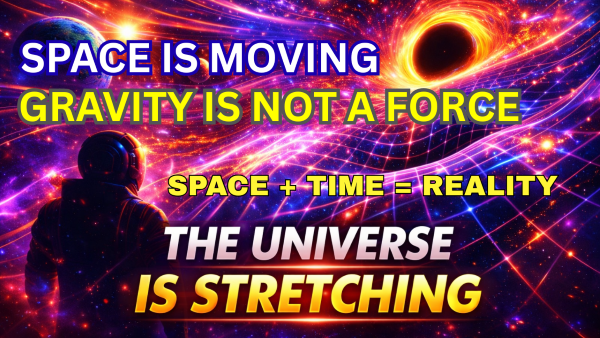
How SpaceTime Works in the Universe: Gravity Explained
Have you ever wondered how spacetime works in the universe and why planets stay in orbit without falling away? Space may look empty, but in reality, it is full of structure, motion, and hidden forces that shape everything around us. From falling apples to black holes, the same invisible system controls it all.
In this blog, we will explore spacetime, gravity, the expanding universe, stars, black holes, and gravitational waves—all in simple English, without complex math. Whether you are a student, a space lover, or a beginner, this guide will help you understand how our universe truly works.
🌠 What Is SpaceTime?
SpaceTime is the combination of space and time into a single structure. Instead of thinking of space and time as separate things, modern physics treats them as one connected system.
Imagine SpaceTime Like a Fabric
Think of the universe as a stretchy fabric or grid:
- Space is the surface
- Time is woven into it
- Everything moves on this fabric
When nothing heavy is nearby, spacetime is flat and calm. Objects move straight and freely.
But when something massive appears, spacetime bends.
🌍 How Gravity Really Works
Many people think gravity is a pulling force. But according to Einstein, gravity works differently.
Gravity Is Curved SpaceTime
Massive objects like stars and planets bend spacetime around them. Smaller objects follow this curve, which looks like gravity.
For example:
- Earth bends spacetime → objects fall down
- The Sun bends spacetime → planets orbit it
So planets are not being “pulled.”
They are simply moving along curved spacetime.
This explanation is a key part of understanding how spacetime works in the universe.
☀️ How Planets Stay in Orbit
Planets move forward in space, but curved spacetime constantly redirects them.
Why Earth Doesn’t Fly Away
- Earth moves straight ahead
- The Sun curves spacetime
- Earth follows the curve and keeps orbiting
The same idea explains:
- The Moon orbiting Earth
- Artificial satellites staying in space
- The International Space Station not falling down
🌌 The Expanding Universe Explained
One of the biggest discoveries of modern astronomy is that the universe is expanding.
What Does Expansion Mean?
Space itself is stretching. Galaxies are not flying through space—
space between them is growing.
As the universe expands:
- Galaxies move farther apart
- Light stretches and becomes redder (redshift)
- The expansion is speeding up
This acceleration is caused by something unknown called dark energy.
💥 The Big Bang: Birth of SpaceTime
Scientists believe the universe began about 13.8 billion years ago.
What Happened at the Beginning?
- The universe was extremely hot and dense
- Space and time expanded suddenly
- Energy turned into matter
- Small differences grew into stars and galaxies
The Big Bang was not an explosion in space—it was the expansion of space itself.
⭐ How Stars Are Born and Die
Stars form when gas clouds collapse under gravity.
Life Cycle of a Star
- Gas gathers and heats up
- Nuclear fusion starts
- A star shines for millions or billions of years
When fuel runs out, the star dies.
🌟 What Happens When Stars Die?
The death of a star depends on its size.
Small and Medium Stars (Like Our Sun)
- Core shrinks into a white dwarf
- Outer layers expand into a glowing cloud
- This cloud is called a planetary nebula
Massive Stars
- Collapse suddenly
- Explode as a supernova
- Core becomes a neutron star or black hole
🕳️ Black Holes and SpaceTime
Black holes are the most extreme example of curved spacetime.
How Black Holes Form
- A massive star collapses
- SpaceTime bends infinitely
- Nothing can escape, not even light
Inside a black hole:
- Space falls inward faster than light
- Time slows down completely
- Known physics stops working
This shows the extreme side of how spacetime works in the universe.
🔄 Spinning Black Holes and Twisted Space
Many black holes rotate.
This rotation:
- Twists spacetime
- Drags nearby matter and light
- Creates a powerful whirlpool effect
Near rotating black holes, even light is forced to move in circles.
🌊 Gravitational Waves: Ripples in SpaceTime
When massive objects move suddenly, they shake spacetime.
These shakes are called gravitational waves.
A Historic Discovery
- In 2015, scientists detected them for the first time
- The waves came from two merging black holes
- They traveled for over a billion years
This discovery opened a new way to study the universe.
🌌 Why SpaceTime Matters to Us
SpaceTime affects everything:
- Why objects fall
- Why clocks tick differently in space
- Why GPS works
- Why the universe evolves
Understanding spacetime helps us understand reality itself.
✅ Conclusion
Space may look empty, but it is alive with motion. SpaceTime bends, stretches, flows, and vibrates, shaping the entire universe. From falling apples to merging black holes, everything follows the same cosmic rules.
By learning how spacetime works in the universe, we gain a deeper understanding of gravity, time, and our place in reality.
👉 If you enjoyed this guide, share it, bookmark it, and explore more science topics that explain the universe in simple language.