
US vs China Moon Race Explained (Artemis II Guide)
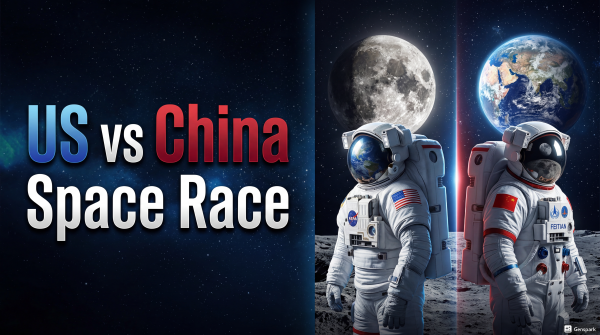
The US vs China Moon race explained is one of the most exciting global stories today. After more than 50 years, humans are returning to the Moon—but this time, it’s not just about exploration.
It’s about competition, technology, and the future of humanity.
The United States is leading the way with the Artemis program, especially the Artemis II mission, while China is rapidly advancing its own lunar ambitions. Both nations are now aiming to build a permanent Moon base.
So, what’s really happening?
Why is the Moon suddenly important again?
And who is ahead in this new space race?
Let’s break it down in simple terms.
🚀 What Is the New Space Race?
The term “space race” originally referred to the competition between the United States and the Soviet Union during the 1960s.
But today, a new space race has begun—and this time, the main competitors are:
- 🇺🇸 United States
- 🇨🇳 China
Unlike the past, this race is not just about reaching the Moon first. Instead, it focuses on:
- Staying on the Moon
- Building infrastructure
- Using lunar resources
👉 In short, it’s about long-term presence in space.
🌕 Artemis II Mission: A Historic Step Forward


The Artemis II mission is a major milestone in NASA’s plan to return humans to the Moon.
🔍 Key Highlights:
- First human mission to lunar orbit in over 50 years
- Astronauts will travel around the Moon (not land yet)
- Tests systems for future Moon landings
This mission is part of a larger plan:
📌 Artemis Program Goals:
- Artemis II → Orbit the Moon
- Artemis III → Land humans on the Moon
- Future missions → Build a sustainable lunar base
👉 The long-term goal?
To prepare for human missions to Mars.
🇨🇳 China’s Rapid Progress in Lunar Exploration


China has made incredible progress in a very short time.
🚀 Major Achievements:
- Landed a rover on the far side of the Moon
- Successfully returned lunar samples
- Planning missions to the south pole of the Moon
🎯 Future Goals:
- Send astronauts by 2030–2032
- Build a permanent Moon base
- Explore lunar resources like Helium-3
👉 China’s strategy is simple:
Move fast, stay focused, and build long-term capabilities.
🌍 Why Is the Moon Important Again?


You might wonder—why go back to the Moon?
The answer lies in resources and strategy.
💡 Key Reasons:
1. Water Ice
- Found near the Moon’s poles
- Can be converted into:
- Oxygen (for breathing)
- Hydrogen (for fuel)
2. Rocket Fuel Production
- Fuel can be created directly on the Moon
- Reduces the need to launch everything from Earth
3. Helium-3
- Rare element with potential for clean energy
- China is especially interested in this
4. Gateway to Mars
- The Moon can act as a launch base for deeper space missions
👉 In simple terms:
The Moon is no longer just a destination—it’s a space hub.
🏗️ The Race to Build a Moon Base


Both the US and China are working toward the same goal:
👉 A permanent Moon base in the early 2030s
⚙️ Challenges of Building a Moon Base:
- Extreme temperatures
- No atmosphere
- Two weeks of daylight and two weeks of darkness
🔋 Power Solutions:
- Solar panels for daytime
- Nuclear reactors for nighttime
🧱 Key Requirements:
- Habitat construction
- Resource extraction systems
- Reliable power supply
👉 This is not science fiction anymore—it’s real planning.
⚖️ US vs China: Who Is Leading?
Here’s a simple comparison:
| Factor | United States 🇺🇸 | China 🇨🇳 |
|---|---|---|
| Experience | Very high (Apollo missions) | Moderate |
| Speed | Slower (due to regulations) | Faster execution |
| Private Sector | Strong (SpaceX, Blue Origin) | Limited independence |
| Long-term Planning | Changing timelines | Consistent goals |
| Innovation | High | Rapidly growing |
🧠 Key Insight:
- The US leads in technology and experience
- China leads in speed and consistency
👉 The race is very close.
🌐 Other Countries in the Space Race
It’s not just the US and China.
🌍 Other Important Players:
- 🇮🇳 India – Successful Moon landing, cost-effective missions
- 🇯🇵 Japan – Advanced robotics and space tech
- 🇪🇺 Europe – Collaborative missions
- 🇳🇿 New Zealand – Private launch capabilities
👉 Space exploration is becoming a global effort.
🤝 Can the US and China Work Together?
Despite competition, cooperation is possible.
🔍 Example:
- The US and Russia still collaborate on the International Space Station
💡 Why Collaboration Matters:
- Faster scientific progress
- Shared knowledge
- Better results for humanity
👉 Scientists often work beyond political boundaries.
📌 Key Takeaways
- The new space race is focused on long-term Moon presence
- The US leads with the Artemis program
- China is advancing quickly with ambitious plans
- The Moon is valuable for resources and future missions
- A permanent Moon base could become reality within a decade
🚀 Conclusion
The US vs China Moon race explained shows us that space exploration has entered a new era.
This time, it’s not just about reaching the Moon—it’s about staying there, building there, and preparing for the future of humanity in space.
Both nations are pushing boundaries, and the competition is driving innovation at an incredible pace.
👉 The real question is:
Who will build the first permanent Moon base?
And more importantly…
👉 How will it shape our future on Earth?