
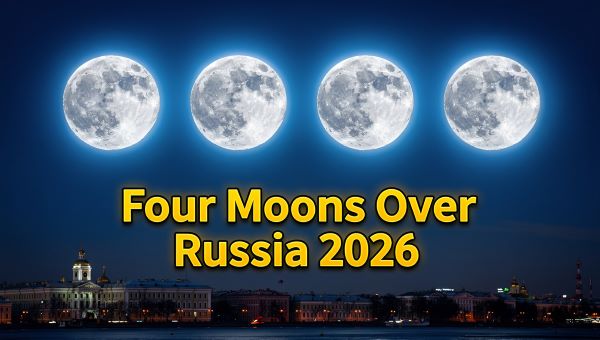
Four Moons Over Russia 2026 Explained
In early February 2026, residents of St. Petersburg looked up at the night sky and saw something unbelievable. It appeared as if four bright moons were glowing at the same height above the horizon. Photos and videos quickly spread online, leaving many people asking the same question: Why did Russia see four moons?
This article, Four Moons Over Russia 2026 Explained, breaks down the science behind this stunning event in simple and clear language. You don’t need a science degree to understand it. By the end, you’ll know exactly what happened — and why it looked so dramatic.
What Happened Over Russia in February 2026?
On a cold winter night in St. Petersburg, observers noticed bright light spots on both sides of the real Moon. These glowing patches were aligned horizontally and appeared almost identical in brightness.
From a distance, it looked like the sky had multiplied the Moon.
Many people wondered:
- Was it a rare astronomical event?
- Did the Moon split?
- Was it a camera glitch?
- Could it be satellites?
But scientists quickly confirmed something important:
The Moon itself was completely normal.
Earth still has only one natural satellite.
The real explanation was happening much closer to home — inside Earth’s atmosphere.
The Real Cause: A Rare Mock Moon Phenomenon in Russia
The event was identified as a paracelene moon dog effect, also known as a mock moon.
This belongs to a group of atmospheric optical effects called halo phenomena.
What Is a Paracelene?
A paracelene is a bright spot that appears on one or both sides of the Moon. It forms when moonlight passes through tiny ice crystals in high-altitude clouds.
These light spots usually appear:
- About 22 degrees from the Moon
- At the same height in the sky
- In symmetrical positions
This is known as the lunar halo 22 degree phenomenon.
How Ice Crystals Created the Illusion
To understand the ice crystals atmospheric illusion, imagine thousands of tiny hexagon-shaped ice plates floating high in the sky.
These crystals form in:
- Cirrus clouds
- Cirrostratus clouds
- Very cold upper atmosphere conditions
Here’s how the effect happens:
- Moonlight enters one side of a hexagonal ice crystal.
- The light bends (this is called refraction).
- It exits at a precise angle — around 22 degrees.
- When millions of crystals do this at once, bright spots appear beside the Moon.
Because the crystals often align horizontally as they fall, the light spots appear at the same height as the Moon.
Why Was the Display So Bright in Russia?
Lunar halo events are usually faint because moonlight is much weaker than sunlight. However, in this case, conditions were nearly perfect.
Several factors made the illusion stronger:
- ❄️ Extremely cold winter air
- 🌫️ Stable high-altitude ice clouds
- 🌕 A bright, nearly full Moon
- 🌌 Clear lower skies without thick cloud cover
Scientists believe the ice crystals were slightly larger than usual. Some may have been wobbling slightly, stretching the light vertically.
This stretching effect made the mock moons appear taller and more dramatic — increasing the illusion that multiple moons were present.
Why Did It Look Like Four Moons?
When the bright patches appeared on both sides of the Moon, and the vertical stretching effect occurred, the sky showed:
- One real Moon
- Two strong side reflections
- Additional layered light structures
To the human eye, especially in a dark winter environment, this looked like four separate moons.
But scientifically, it was still just one Moon — with atmospheric light refraction.
Is This Event Dangerous?
No. The Four Moons Over Russia 2026 Explained event was completely harmless.
It does not indicate:
- Changes in the Moon’s orbit
- Space anomalies
- Planetary alignment
- Celestial danger
It is purely an atmospheric optical effect.
Can This Happen Again?
Yes — but it’s rare.
Mock moons are more likely when:
- Temperatures are below freezing
- Thin cirrus clouds are present
- The Moon is bright (near full phase)
- The sky near the horizon is clear
These conditions can occur anywhere in the world — not just Russia.
Every event will look slightly different because:
- Ice crystal sizes vary
- Cloud thickness changes
- Crystal alignment is never perfect
That’s why each display is unique.
Why Events Like This Go Viral
Today, high-quality smartphone cameras can capture subtle sky phenomena that once went unnoticed.
When something unusual appears in the sky:
- Photos spread quickly
- Social media amplifies speculation
- Scientific explanations follow
Events like this create curiosity and also offer a great opportunity to learn about atmospheric science.
They remind us that sometimes the most dramatic sky events happen inside our own atmosphere — not in deep space.
The Science Behind the 22-Degree Halo
The 22-degree angle is not random.
It is determined by the geometry of hexagonal ice crystals.
Light passing through these crystals bends at a consistent angle because of:
- The internal structure of ice
- The refractive index of frozen water
- The orientation of crystal faces
This predictable angle is why both solar halos and lunar halos often appear at the same distance from the light source.
Key Takeaways
Let’s summarize the most important points:
✔ There were not actually four moons
✔ The Moon’s position and brightness were normal
✔ The effect was caused by ice crystals
✔ It is called a paracelene or mock moon
✔ It forms at about 22 degrees from the Moon
✔ It is rare but completely natural
Conclusion
The “four moons” seen over St. Petersburg in 2026 were not a space mystery. They were a beautiful and rare atmospheric illusion.
Understanding the science behind the event makes it even more fascinating. The next time you see something unusual in the night sky, remember — the explanation may be closer than you think.
If you enjoy learning about rare sky phenomena and space science in simple language, keep exploring and stay curious. 🌕✨