
Why China Didn’t Copy NASA: Real Space StoryThe
To better understand why China didn’t copy NASA, readers can explore information from leading space organisations, including NASA , the China National Space Administration , the NASA Artemis Program, the European Space Agency , and the United Nations Office for Outer Space Affairs .
These official sources provide valuable insights into global space exploration, international cooperation, and the different strategies that have shaped modern space programmes.
Many people assume that China’s rapid rise in space technology happened because it copied the work of other nations, especially the United States. After all, NASA spent decades building rockets, spacecraft, satellites, and space stations. If those technologies already existed, wouldn’t it have been easier for China to simply follow the same path?
The reality is far more interesting that why China didn’t copy NASA.
China’s rise as a major space power is not just a story about technology. It is a story about politics, scientific determination, national strategy, and the unexpected consequences of international isolation. Over several decades, China developed an entirely different approach to space exploration, building systems that often look very different from those used by NASA.
Today, China operates its own space station, runs a global satellite navigation system, conducts advanced lunar missions, and plans future Moon exploration projects. Yet many of these achievements were developed independently.
In this article, we’ll explore the historical events, political decisions, and engineering breakthroughs that explain how China became one of the world’s leading space nations and why China didn’t copy NASA.
The Myth That China Simply Copied NASA
One of the most common assumptions about China’s success is that it reverse-engineered existing technologies.
At first glance, this idea seems reasonable.
The United States has been exploring space since the 1950s. NASA landed humans on the Moon in 1969 and has developed some of the most advanced space technologies in history.
So many people naturally assume China followed the same blueprint.
However, a closer look reveals major differences.
China’s Systems Are Different
Consider these examples:
- China uses the BeiDou Navigation System instead of GPS.
- China’s Tiangong Space Station is separate from the International Space Station.
- Chinese spacecraft use different docking mechanisms.
- Chinese launch vehicles use different engineering approaches.
- Mission planning follows different organizational structures.
These are not minor adjustments.
They are examples of an entirely different technological ecosystem.
If China truly copied NASA, most systems would be compatible. Instead, many are designed to operate independently.
To understand why, we need to go back several decades.
The Man Who Changed China’s Space Future
Qian Xuesen: The Scientist Behind China’s Space Dream
Every major space program has a founder figure.
For China, that person was Qian Xuesen.
Qian was not only one of China’s most important scientists but also one of the most influential aerospace engineers of the twentieth century.
He studied in the United States and became a respected researcher at the California Institute of Technology.
Working alongside leading scientists, Qian contributed to early rocket and aerodynamics research.
His expertise was so valuable that he became deeply involved in American aerospace projects.
Many historians believe he had the potential to become one of the most important figures in America’s future space efforts.
But history took a different turn.
The Cold War Changes Everything
During the early Cold War years, political tensions increased dramatically.
Concerns about communist influence spread throughout the United States.
Qian became the target of investigations and accusations regarding political affiliations.
His security clearance was revoked.
His professional opportunities were restricted.
After years of uncertainty, he was deported to China in 1955.
Few people realized the impact this decision would have.
When Qian arrived in China, he immediately began helping build the country’s missile and aerospace research programs.
The foundations of modern Chinese space exploration were being established.
What appeared to be a political decision eventually became one of the most significant events in the history of global space competition.
Early Soviet Assistance and an Unexpected Crisis
China Looks to the Soviet Union
During the 1950s, China sought technological support from the Soviet Union.
At the time, the Soviet Union was one of the world’s leading space powers.
Cooperation included:
- Technical training
- Rocket engineering assistance
- Scientific exchanges
- Missile development support
For several years, progress moved forward steadily.
China appeared to be following the traditional path used by many developing technological programs: learn from established experts and gradually build domestic capabilities.
The Sino-Soviet Split
Everything changed in 1960.
Political disagreements caused relations between China and the Soviet Union to collapse.
Soviet advisers left China.
Technical support ended.
Research projects stalled.
Important expertise disappeared almost overnight.
This was a major setback.
Many expected China’s space ambitions to slow dramatically.
Instead, the opposite happened.
Why Isolation Forced Innovation
When foreign assistance vanished, Chinese engineers faced a difficult challenge.
There was no longer a partner available to provide solutions.
The only option was self-reliance and the only reason for why China didn’t copy NASA.
Building Domestic Expertise
Chinese scientists focused on:
- Creating national research institutions
- Training engineers domestically
- Developing independent technologies
- Building local manufacturing capabilities
This process was not easy.
Progress often moved slower than it would have with international support.
However, the benefits became clear over time.
Independence Became a Strength
Because China could not rely on outside systems, it learned to solve problems internally.
This encouraged:
- Innovation
- Technical flexibility
- Long-term planning
- Domestic talent development
Many experts now believe that this period of isolation played a crucial role in shaping China’s independent engineering culture.
The Wolf Amendment and a New Era of Separation
Several decades later, another major event influenced the future of China’s space program.
What Is the Wolf Amendment?
In 2011, the United States passed legislation known as the Wolf Amendment.
The law restricted direct bilateral cooperation between NASA and Chinese government space organizations.
The restrictions affected:
- Joint missions
- Research partnerships
- Scientific exchanges
- Certain collaborative projects
As a result, China remained outside many major international space initiatives.
Most notably, it was excluded from participation in the International Space Station program.
The Unintended Consequence
Many observers believed these restrictions would slow China’s progress.
Instead, they encouraged China to accelerate development of its own infrastructure.
Rather than joining existing systems, China began investing heavily in independent alternatives.
This included:
- Human spaceflight programs
- Satellite networks
- Lunar exploration projects
- Deep-space missions
- Space station development
What started as exclusion gradually strengthened China’s determination to build a fully independent space ecosystem.
Building an Entire Space Ecosystem
Most people think of rockets when they hear the term “space program.”
In reality, successful space exploration requires much more.
China invested in every major component necessary for long-term space operations.
Key Components of China’s Space Infrastructure
- Launch vehicles
- Human spaceflight systems
- Satellite networks
- Deep-space communication systems
- Scientific research facilities
- Navigation services
- Lunar exploration programs
Instead of borrowing existing architectures, China built systems specifically designed for its own objectives.
This approach helped create one of the most comprehensive independent space programs in the world.
The Tiangong Space Station: China’s Independent Laboratory in Orbit
One of the clearest examples of why China didn’t copy NASA and how China chose a different path is the Tiangong Space Station.
When people think of space stations, they usually think of the International Space Station (ISS). The ISS represents cooperation among multiple countries and space agencies. China, however, was never allowed to participate in that project.
Instead of waiting for an opportunity to join, China decided to build its own station.
What Is Tiangong?
The word “Tiangong” means “Heavenly Palace.”
It is a fully operational space station orbiting Earth and serves as China’s primary platform for long-term human spaceflight and scientific research.
Tiangong allows Chinese astronauts to:
- Conduct scientific experiments
- Test new technologies
- Study human health in space
- Observe Earth and space environments
- Prepare for future deep-space missions
Why Tiangong Matters
The success of Tiangong proves that China can independently:
- Design a space station
- Launch modules into orbit
- Support astronauts for long durations
- Conduct advanced space research
For many experts, Tiangong represents China’s arrival as a major space power.
Most people use GPS every day without thinking about it.
GPS helps smartphones provide directions, supports transportation systems, and enables many modern technologies.
However, GPS is controlled by the United States.
China wanted an independent alternative.
What Is BeiDou?
The BeiDou Navigation Satellite System is China’s global navigation network.
Like GPS, it provides:
- Positioning services
- Navigation support
- Timing information
- Emergency communication capabilities
Today, BeiDou covers the entire world.
Why Build a Separate System?
There were several reasons:
- National Security
- Technological Independence
- Economic Development
- Strategic Reliability
By building BeiDou, China reduced dependence on foreign systems and strengthened its technological infrastructure.
This decision perfectly illustrates China’s broader approach to innovation.
Instead of relying on existing solutions, it created its own.
China’s Moon Missions Are Making History
China’s lunar exploration program has produced some of the most impressive achievements in modern space exploration.
Landing on the Far Side of the Moon
In 2019, China became the first nation in history to land a spacecraft on the far side of the Moon.
This was an extraordinary achievement because the far side never directly faces Earth.
Communicating with a spacecraft there requires special relay satellites and advanced mission planning.
The mission demonstrated China’s growing capabilities in:
- Deep-space communication
- Autonomous spacecraft operations
- Lunar exploration technology
Returning Samples From the Far Side
China later achieved another historic milestone by bringing samples back from the Moon’s far side.
No other nation had accomplished this before.
Scientists believe these samples may help answer important questions about:
- Lunar formation
- Geological evolution
- Early solar system history
These achievements show that China’s space program is not simply following existing paths.
In several areas, it is setting new records.
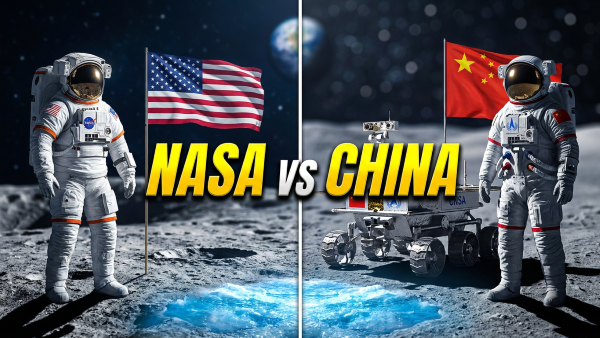
NASA vs China: Different Approaches to Space Exploration
The discussion often becomes framed as NASA versus China.
While comparisons are natural, the reality is more complex.
Both organizations pursue space exploration using different models.
NASA’s Approach
NASA often works through partnerships with:
- Private companies
- Universities
- International agencies
Advantages include:
- Global cooperation
- Shared expertise
- Diverse innovation
Challenges include:
- Complex coordination
- Political budget changes
- Long approval processes
China’s Approach
China uses a more centralized system.
Advantages include:
- Long-term planning
- Consistent funding
- Faster decision-making
- Unified goals
Challenges include:
- Less international participation
- Greater dependence on domestic resources
Neither system is perfect.
Each reflects different political, economic, and strategic priorities.
Comparison Table: NASA vs China Space Program
| Feature | NASA | China |
|---|---|---|
| Navigation System | GPS | BeiDou |
| Space Station | International Space Station Partner | Tiangong Space Station |
| Moon Program | Artemis Program | Chang’e Program |
| Management Style | Partnerships & Contractors | Centralized Planning |
| International Cooperation | Extensive | Selective |
| Human Spaceflight History | Since 1961 | Since 2003 |
| Current Lunar Goals | Return Humans to Moon | Human Lunar Missions |
The Power of Starting Later
At first glance, entering the space race later appears to be a disadvantage.
However, it can also provide unexpected benefits.
Avoiding Legacy Systems
Many older space programs must maintain decades-old technologies.
Updating these systems can be expensive and time-consuming.
China entered the modern era of space exploration later, allowing it to build around:
- Modern computing
- Advanced automation
- Digital communications
- New manufacturing techniques
This process is often called “technological leapfrogging.”
Instead of slowly upgrading old systems, China could build newer systems from the start.
Faster Adoption of New Technologies
Because of this advantage, many Chinese programs incorporate modern technologies from the beginning.
Examples include:
- Automated docking systems
- Advanced spacecraft controls
- Modern navigation networks
- Digital mission planning
This has helped accelerate development in several areas.
China’s Future Space Ambitions
China’s space program is far from finished.
In fact, many of its biggest projects are still ahead.
Planned Human Moon Missions
China is actively developing technologies that could support future crewed lunar missions.
These efforts include:
- Lunar landers
- Heavy-lift rockets
- Surface exploration systems
Future Lunar Research Bases
China has expressed interest in establishing long-term lunar research facilities.
Such bases could support:
- Scientific research
- Resource studies
- International cooperation
Advanced Space Telescopes
Future observatories may help scientists study:
- Distant galaxies
- Dark matter
- Planet formation
- Cosmic evolution
These projects demonstrate that China is thinking beyond Earth orbit and planning for the next era of space exploration.
Frequently Asked Questions (FAQs)
1. Why China didn’t copy NASA even though NASA was ahead in space technology?
The main reason why China didn’t copy NASA is that China had limited access to NASA’s technology and space programs for decades. Instead of relying on American systems, China focused on developing its own rockets, satellites, navigation systems, and space stations. Understanding why China didn’t copy NASA helps explain how China created an independent space ecosystem.
Yes. A major factor behind why China didn’t copy NASA was political separation between the United States and China. Restrictions such as the Wolf Amendment limited cooperation between NASA and Chinese space organizations. This situation influenced why China didn’t copy NASA and encouraged China to invest heavily in its own technologies and research programs.
3. How does Tiangong explain why China didn’t copy NASA?
The Tiangong Space Station is one of the best examples of why China didn’t copy NASA. Rather than joining the International Space Station, China built its own orbital laboratory. The success of Tiangong demonstrates why China didn’t copy NASA and instead chose to develop independent solutions for human spaceflight and scientific research.
4. Did why China didn’t copy NASA help China become a space superpower?
Many experts believe that why China didn’t copy NASA is actually one of the reasons behind China’s success. Because China developed its own systems, it gained valuable experience in engineering, innovation, and long-term planning. The story of why China didn’t copy NASA shows how self-reliance can sometimes create stronger technological capabilities.
5. What can we learn from why China didn’t copy NASA?
The biggest lesson from why China didn’t copy NASA is that innovation does not always require following existing models. By building independent technologies such as the BeiDou Navigation System, Tiangong Space Station, and advanced lunar missions, China demonstrated why China didn’t copy NASA and how a unique approach can lead to major achievements in space exploration.
Conclusion
The story of why China didn’t copy NASA is about much more than space technology.
It is a story of historical events, political decisions, scientific determination, and long-term planning.
From the return of Qian Xuesen to the creation of the Tiangong Space Station, China’s space program evolved under unique circumstances. Exclusion from major international projects and limited cooperation opportunities pushed Chinese engineers to build independent systems rather than rely on existing ones.
The result is a space program that includes its own navigation network, space station, lunar exploration missions, and ambitious plans for the future.
Whether viewed as competition or innovation, China’s rise has changed the global space landscape.
As humanity prepares for future Moon missions, deep-space exploration, and new scientific discoveries, China’s role will continue to grow.
The next chapter of space exploration will not be written by one nation alone. It will be shaped by multiple space powers pushing the boundaries of what is possible.
And that makes the future of space more exciting than ever.