
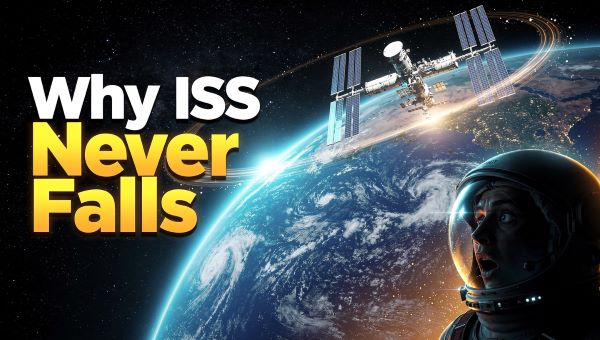
Why the ISS Never Falls to Earth: 7 Amazing Space Facts
Every night above our heads, a giant machine bigger than a football field travels around Earth at an unbelievable speed. This giant structure is called the International Space Station, or ISS. Many people wonder why the ISS never falls to Earth even though our planet’s gravity constantly pulls objects downward.
The answer lies in the fascinating science of orbit, gravity, and motion that allows the ISS to continuously circle Earth without crashing and ISS never falls to Earth.
According to NASA Official ISS Page, the ISS travels at nearly 28,000 kilometers per hour while orbiting around 400 kilometers above Earth. You can also learn more about orbital science from European Space Agency (ESA) and detailed space research from Space.com ISS Guide.
The ISS weighs hundreds of tons, Earth’s gravity is constantly pulling it downward, and yet ISS never falls to Earth or into the planet.
So what is really happening?
Many people think the ISS is somehow escaping gravity, but that is not true at all. In reality, the ISS is actually falling toward Earth all the time. The reason ISS never falls to Earth is because of speed and orbit.
In this article, you will learn why the ISS never falls to Earth, how orbit works, why astronauts float, and what may happen to the ISS in the future.
Why Doesn’t the ISS Fall to Earth?
The International Space Station: Humanity’s Home in Space
- 1. The International Space Station: Humanity’s Home in Space
- 2. What Is an Orbit?
- 3. Why Gravity Does Not Pull the ISS Down
- 4. Imagine Throwing a Ball
- 5. How the ISS Stays in Orbit
- 6. ISS Orbit Explained Simply
- 7. How Fast Does the ISS Travel?
- 8. Why Astronauts Float Inside the ISS
- 9. How Was the ISS Built?
- 10. Why Was the ISS Created?
- 11. Main Goals of the ISS
- 12. Does the Moon Affect the ISS?
- 13. What Happens If the ISS Slows Down?
- 14. What Fuel Helps the ISS never falls to Earth ?
- 15. Life Inside the ISS
- 16. Daily Activities of Astronauts
- 17. Challenges of Living in Space
- 18. Main Challenges
- 19. Will the ISS never falls to Earth and Stay in Space Forever?
- 20. What Will Happen to the ISS in the Future?
- 21. Why the ISS Is Important for Humanity
- 22. Amazing ISS Facts
- 23. Earth vs ISS Comparison Table
- 24. Conclusion
The International Space Station is one of the greatest scientific projects ever created by humans.
It was built through cooperation between several countries and space agencies including NASA.
The ISS acts like a giant laboratory in space where astronauts live and perform experiments.


Quick Facts About the ISS
| Feature | Details |
|---|---|
| Orbit Height | Around 400 km above Earth |
| Speed | About 28,000 km/h |
| Orbit Time | 90 minutes |
| Weight | Around 460 tons |
| Length | Similar to a football field |
| Purpose | Scientific research |
The ISS circles Earth about 16 times every single day.
That means astronauts onboard can see multiple sunrises and sunsets within 24 hours.
What Is an Orbit?
To understand why the ISS never falls to Earth, you first need to understand orbit.
An orbit happens when one object moves around another object because of gravity and speed.
The Moon orbits Earth.
Earth orbits the Sun.
And the ISS orbits Earth.
But the ISS stays much closer to Earth compared to the Moon.
Why Gravity Does Not Pull the ISS Down
Many people believe there is no gravity in space.
Actually, gravity exists almost everywhere in space.
Even where the ISS travels, Earth’s gravity is still very strong.
So why doesn’t gravity pull it down?
The answer is simple:
The ISS is moving sideways extremely fast.
Imagine Throwing a Ball
Think about throwing a ball.
If you throw it gently, it falls nearby.
If you throw it harder, it travels farther before falling.
Now imagine throwing something so fast that while it falls, Earth curves away beneath it.
That object would keep missing Earth forever.
That is exactly what the ISS does.


The ISS constantly falls toward Earth because of gravity.
But because it moves at nearly 28,000 kilometers per hour, it keeps missing the surface.
This continuous falling around Earth is called orbit.
How the ISS Stays in Orbit
The ISS survives because two important forces work together perfectly.
1. Gravity
Earth’s gravity pulls the station inward.
Without gravity, the ISS would fly away into deep space.
2. Forward Speed
The ISS moves sideways at tremendous speed.
This forward motion prevents it from crashing directly into Earth.
These two forces balance each other.
That balance creates a stable orbit.
ISS Orbit Explained Simply
The easiest way to understand orbit is with a spinning stone.
Imagine tying a stone to a rope and spinning it around your hand.
The rope keeps pulling the stone inward while the stone keeps moving forward.
The ISS works in a similar way.
- Gravity acts like the rope
- Speed keeps the ISS moving forward
Together, they create orbit.
How Fast Does the ISS Travel?
The ISS travels incredibly fast.
It moves at around:
- 28,000 km/h
- 17,500 mph
At this speed:
- It circles Earth every 90 minutes
- It experiences 16 sunrises daily
- It travels faster than a bullet


Its speed is one of the biggest reasons it stays in orbit.
Why Astronauts Float Inside the ISS
Astronauts appear to float because everything inside the ISS is falling together at the same speed.
This creates microgravity.
The astronauts are not escaping gravity.
Instead, they are continuously falling around Earth along with the station.
That is why they float freely inside the ISS.
How Was the ISS Built?
The International Space Station was too large to launch in one piece.
So scientists built it step by step in space.
Different rockets carried different modules into orbit over many years.
Astronauts then connected the modules together during space missions.


The first ISS module launched in 1998.
Since then, the station has continued growing through multiple missions.
Why Was the ISS Created?
Scientists built the ISS for many important reasons.
Main Goals of the ISS
Scientific Research
Experiments behave differently in microgravity.
Scientists study:
- Medicine
- Physics
- Biology
- Plants
- Human health
Future Space Missions
The ISS helps prepare humans for future Moon and Mars missions.
Earth Observation
Astronauts can study Earth’s climate, weather, and environment from orbit.
Technology Testing
The station acts like a testing center for future space technologies.
Does the Moon Affect the ISS?
The Moon does influence Earth and nearby objects with gravity.
The Moon creates tides in Earth’s oceans.
However, Earth’s gravity is much stronger on the ISS because the station is much closer to Earth than the Moon is.
So Earth remains the main force controlling the ISS orbit.
What Happens If the ISS Slows Down?
If the ISS lost speed, gravity would eventually pull it back to Earth.
Even though space looks empty, tiny atmospheric particles still exist around Earth.
These particles create drag.
Drag slowly reduces the ISS speed over time.
That is why scientists occasionally boost the ISS higher using spacecraft engines.
Without these boosts, the ISS would eventually re-enter Earth’s atmosphere.
What Fuel Helps the ISS never falls to Earth ?
The ISS itself does not continuously use giant rocket engines.
Instead, visiting spacecraft provide orbital boosts when needed.
Some spacecraft used for this include:
- Soyuz spacecraft
- Progress spacecraft
- Cargo missions
These vehicles help maintain the ISS orbit and position.
Life Inside the ISS
Living in space is very different from living on Earth.
Astronauts must adapt to microgravity and limited space.


Daily Activities of Astronauts
- Scientific experiments
- Exercise
- Equipment maintenance
- Communication with Earth
- Spacewalk training
Astronauts must exercise regularly because muscles weaken in microgravity.
Challenges of Living in Space
Life in orbit is exciting but difficult.
Main Challenges
Muscle and Bone Loss
Without gravity, muscles become weaker.
Radiation
Space radiation can damage the human body.
Isolation
Astronauts stay far away from family and friends for months.
Limited Resources
Everything onboard must be carefully managed.
The ISS helps scientists solve these problems for future deep-space missions.
Will the ISS never falls to Earth and Stay in Space Forever?
No.
The ISS will eventually retire.
After decades in orbit, maintenance becomes more difficult and expensive.
Scientists already have plans for its future.
What Will Happen to the ISS in the Future?
When the ISS mission ends, scientists will slowly lower its orbit.
Eventually, the station will enter Earth’s atmosphere.
Most of it will burn because of extreme friction and heat.
Remaining debris may fall into remote ocean areas.


This controlled re-entry will help ensure safety on Earth.
Why the ISS Is Important for Humanity
The ISS is more than just a space station.
It represents:
- Human innovation
- International teamwork
- Scientific curiosity
- Future exploration
The knowledge gained from the ISS may help humans someday live on the Moon or Mars.
Amazing ISS Facts
Interesting Facts About the ISS
- The ISS is visible from Earth without a telescope
- Astronauts recycle water in space
- The station is larger than a six-bedroom house
- It travels faster than most spacecraft from early space missions
- Humans have continuously lived there since 2000
Earth vs ISS Comparison Table
| Feature | Earth | ISS |
|---|---|---|
| Gravity | Normal gravity | Microgravity |
| Atmosphere | Thick | Very thin |
| Speed | Earth rotation | 28,000 km/h |
| Day Length | 24 hours | 90-minute orbit |
| Living Conditions | Natural | Artificial |
Conclusion
The mystery behind why the ISS never falls to Earth becomes surprisingly simple once we understand orbit and gravity.
The International Space Station stays in space because gravity pulls it downward while its incredible speed keeps it moving forward around Earth.
In other words, the ISS is constantly falling toward Earth but keeps missing it because it moves so fast sideways.
This perfect balance allows astronauts to live and work in orbit for years.
The ISS stands as one of humanity’s greatest scientific achievements and continues helping scientists prepare for the future of space exploration.
As humans dream about reaching Mars and building colonies beyond Earth, the lessons learned from the ISS will play a huge role in shaping the future of space travel.