
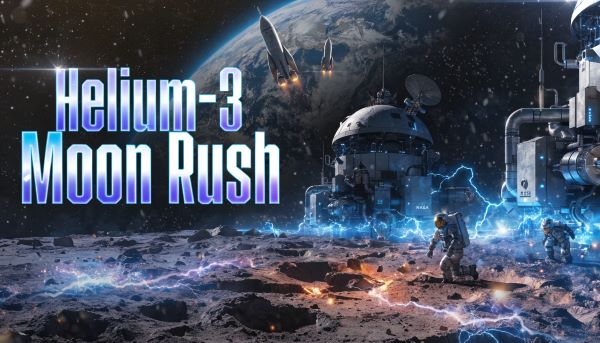
Amazing Helium-3 Moon Mining Future Energy Revolution

The topic of Helium-3 Moon Mining is gaining global attention because scientists believe the Moon holds large amounts of a rare substance called Helium-3. This material could someday help create clean and powerful Nuclear Fusion energy — the same process that powers the Sun. According to research shared by NASA and the International Atomic Energy Agency at IAEA, future fusion technology could transform the global clean energy sector and reduce dependence on fossil fuels.

Countries like the United States and China are already preparing for this future through ambitious Moon missions. What once looked like science fiction is slowly becoming reality.

Could the Moon really solve Earth’s future energy crisis?
Let’s explore the science, technology, opportunities, and risks behind the new lunar gold rush.

🌌 The Moon: More Than Just a Rock in Space

For decades, many people believed the Moon was simply a lifeless world made of dust and rocks. But scientists later discovered that the lunar surface contains valuable materials that could become extremely important in the future.

One of those materials is Helium-3.

The Secret Resource on the Moon that could Power Earth Forever(Helium-3)

https://images.openai.com/static-rsc-4/3WuItuf5SnhOwdu7-akm2d73HDFMBzSyiHIvLAAM4jJVSptZDK2wLeEYCNI-7NXY2PFslutOv8ckEMjypVbVtHIB_-6BQ0IKELgkQLbdzAIpK264efDTQunRgh18oVrBzlEJ-brMZRNTO0x1n6B-GvlrwbzRI7bmmDh1t2f50agBQQybnzdYPrthTLurXQR7?purpose=fullsize
https://images.openai.com/static-rsc-4/hnLagf04WnFn3POa0bI0PjwDgqmdOTk_7q3_98-luPIivdMFN7ayzFLTh9ZCrydfcGspkb13pO5DlIrTQcKWqRDSik5nFFs0c17qXFyT11zkXehG7NHaafK623Tm_VIWrKn9Ie37Jo1wum5UWAvIm6nzO8Rvelb1Lw9GQoXtf3GwixNLYtG3UNE0_WCW6UH7?purpose=fullsize
https://images.openai.com/static-rsc-4/1Q7RnG_4HDwCQqb-nYFMMgFBR1YpADB0GWr0NWbrNe3Vt_JIt1t_LAmBeii_i8SChMyPGTV9jJFcAsWwQk8i-85kAYNZPI869b_FRFNEwqo8_tJhI2EeU_b9xbignQ8HmfqotqEKITkRTmhQVA6irkhzWt6TQxtdqSQjpFmfYvKiRUJ659ARLSwaqIGdY1OZ?purpose=fullsize
6

Unlike Earth, the Moon has no thick atmosphere or protective magnetic field. Because of this, particles from the Sun have directly hit the lunar surface for billions of years.

These solar particles deposited Helium-3 into the Moon’s dusty soil, also known as lunar regolith.

Scientists now believe the Moon may contain enormous amounts of this rare material.

What Is Helium-3?

Helium-3 is a rare isotope of helium. It is different from the normal helium used in balloons because it contains fewer neutrons.

Although it sounds simple, this tiny difference makes Helium-3 incredibly valuable for future energy systems.

Why Scientists Want Helium-3

Researchers believe Helium-3 could be used in advanced Nuclear Fusion reactors to create clean and efficient energy.

Possible advantages include:

  • Very low pollution
  • Minimal radioactive waste
  • High energy output
  • Long-term sustainability
  • Safer fusion reactions

This is why many experts call Helium-3 the “holy grail” of clean energy.

☀️ Understanding Nuclear Fusion in Simple English

Fusion is one of the most powerful natural processes in the universe.

It happens inside stars, including our Sun.

Instead of breaking atoms apart like current nuclear reactors do, fusion combines tiny atoms together. During this process, enormous amounts of energy are released.

Think of it like combining small Lego blocks into a larger structure while releasing energy at the same time.

https://images.openai.com/static-rsc-4/Gorl40iRB0WYKA-fKbKBw6JqnpIlsArDAcEXTNMYyf7c_OMxF71o4tQTV95-ja2YylgroZAchlk_kPOwsXQsUwwq-ZhlOcJ5vpk7wtH9bHgX3z29zp4KNuAf1DraA8-f2lwd0ZyhJQxcLF6h6r4hvm0NJB_VyYqOql6Yqp0VDHysHX79E0EOiJtrQqwx4ACv?purpose=fullsize
https://images.openai.com/static-rsc-4/HMvj0Jeb2F1Re4oL5iWhcvtcr_s5gCvz7hoFucwLirIiecr6kt9RJvEqsnAqciTMVif9bOx0_y9H-0M5Z0x8oqWeW_e7j1kWD2-6UP5iFZDLadMD8pThesiyybA3TnyBI_PnbydtSLa091oJVYdMmTh4AIJwG3nJ-xu9HB5H5RGb_ndHmztuPco0n0xktUZH?purpose=fullsize
https://images.openai.com/static-rsc-4/y5hjNn0qdgPeeSkZl72z6sL7mIxEbMr1C-P35BJK1aQznsVClmi5Sql7mugHQ7bk2gPl-ThPxAEAKWvcHMkwKVLBNIUq0zxRDHTsxcx47iSgXwLYdzMMvG6ue2WjPjkAJhbIgh-B92PxdtSCel5Cq6kaffIYcBIMNm04LTkEU2Uk4lHlRJjwMFVHfbkt_v2f?purpose=fullsize
7

Why Fusion Energy Is So Important

Fusion has the potential to change human civilization because it could provide:

  • Nearly unlimited clean energy
  • Reduced carbon emissions
  • Less dependence on fossil fuels
  • Reliable future electricity systems
  • Energy for future space exploration

Scientists around the world are currently trying to build working fusion reactors, but the process is extremely difficult.

Fusion requires temperatures hotter than the core of the Sun.

🌕 Why the Moon Contains Helium-3

Earth is protected by a magnetic field that blocks most solar radiation. While this protection makes life possible, it also prevents large amounts of Helium-3 from reaching our planet.

The Moon has no such protection.

For billions of years, solar winds from the Sun directly deposited Helium-3 onto the lunar surface.

This makes the Moon one of the richest known sources of Helium-3 in our solar system.

Some scientists estimate there may be over one million tons of Helium-3 spread across the Moon.

If future fusion technology succeeds, this material could become one of the most valuable resources in human history.

🚀 The Artemis Program and Lunar Mining

The United States is already preparing for long-term Moon exploration through NASA’s Artemis Program Moon Mission.

Unlike Apollo missions, which focused mainly on landing astronauts, Artemis aims to create sustainable lunar infrastructure.

Goals of the Artemis Program

NASA plans to:

  • Return astronauts to the Moon
  • Build long-term Moon bases
  • Develop advanced space technologies
  • Prepare for Mars exploration
  • Study lunar resources
https://images.openai.com/static-rsc-4/yVjRM04-MwOz2y9d9JdufT8Nsdj8i-Dtvo0Jhmp-Yd0XSzNv2IOB-3oqOV4G_JAY_wOtvc6IzCfzJGdtoUfuiGHIIY54us5HHMxVw5T9v0ZYqVsbZCgVW0P5FneCLS9MDYGqEpTwu_NpNfeh13co6A9rsifAVTcsG3KANqawFbC4DoplhJOyddu31r61Bjy2?purpose=fullsize
https://images.openai.com/static-rsc-4/GGeP6finzYkxNBAPsjHUih-qohErd79C9D_tqPcaSX8M_mfqpy3CQeG7OktmULfV5mMb3rwTU-apGbecANK5vHF91NZt9JyJCigxbBYuR0rNDu6Ovoh38WWyNU1WB2LEBqrAktAhUChT9hPTbt8NnTqRIJMVmZ41gm2f8CdfwAbUdQl-TNFvyVto6QxoDaJE?purpose=fullsize
https://images.openai.com/static-rsc-4/ifXRlwTcFZ9GSPQSvKcT6uRQr4OPOCoF-sb-Z9_Av_R9Wy2cBdEjO9ddVWYDOm8XbD1xPJh-Ll-gH3-WLdUGSwEe6ELz7z24ok-Tn8l_QxcD4x48EE7wdq3tpQkhn9QWNdjOq5_zMKdV8j58GwTUb85IsIkwdwvT7l2YFJXsaPZZmHIEsK_9MZ19U6yV7VJI?purpose=fullsize
6

Many experts believe these future Moon bases could eventually support Lunar Mining Technology operations.

Why the Moon’s South Pole Matters

Scientists believe the south pole of the Moon may contain:

  • Water ice
  • Useful minerals
  • Stable sunlight regions
  • Future fuel resources

Water could be converted into oxygen for breathing and hydrogen for rocket fuel.

🇨🇳 China and Space Race 2.0

China has also become a major player in lunar exploration.

Its Chang’e missions have achieved historic milestones, including:

  • Landing on the far side of the Moon
  • Returning lunar samples to Earth
  • Testing robotic lunar technologies

China has openly discussed plans for future Moon bases and resource extraction projects.

This growing competition between nations is often called Space Race 2.0.

https://images.openai.com/static-rsc-4/hwcmxUTzmwCipYPxlY6h2EO-Wyyk6zljRXrnb-g7N0smvflotCJC3vp8GPm1J19o-RmS-QJWb0ibYZs-IDzUDAgLWwnhgn5cGCpXqChBn45OSE0xA-lw7NIYkDH5Bx8ZLU8JQ5-MXbPhj_VIsf4Hc6RreKAYjI-0UHxaR6yOdHam9rttdoU53F3JfFXrxK2w?purpose=fullsize
https://images.openai.com/static-rsc-4/HSsc1CyDMLtBxlgL1O09PGuv36DBrFM52nr73rhBwj3qPxG1wwCdywfa2dBa5SAq192jZdvY3hdBEVZ0pq7Tr91EVKTSPyIw6pzJYlvBM5JnxPYH8D7nWfYdRWB07YRgAts1TvQ_mCjVr5ugSC0y1Y0tvOHuGokWoOYFLi3ZaKGAiXW-QfGhTSjnKmiL_aDg?purpose=fullsize
https://images.openai.com/static-rsc-4/pypiL1R_A5Bo9UZny_Q6_iI4yAYOmOBr66wM13a1WnVddO3cLMViLi-Y2L0SfQt8LuUQdWXXPh4ABwa16FuNmh6fLkIE4uLpQuF8JRdLyK2lysjTpBslrhqWVHBJWyvS51Tv98o1TMaEPyMOYzOdHtkDHCRUztMYq5iKBqD30b2NzcVLWmzbA-_K6pkW9O3B?purpose=fullsize
6

How Today’s Space Race Is Different

The original space race during the Cold War focused mainly on political prestige.

Today’s race is about:

  • Future energy
  • Space resources
  • Technology leadership
  • Economic power
  • Lunar mining opportunities

The Moon is no longer just a scientific target. It is becoming an economic frontier.

⚡ Challenges of Helium-3 Moon Mining

Even though the idea sounds exciting, extracting Helium-3 from the Moon is extremely difficult.

Major Challenges Include

1. Harsh Lunar Environment

The Moon experiences:

  • Extreme temperatures
  • Dangerous radiation
  • Sharp lunar dust
  • No breathable atmosphere

2. High Transportation Costs

Sending equipment and people to the Moon remains very expensive.

3. Difficult Mining Process

Helium-3 exists in low concentrations within lunar soil. Large amounts of regolith must be heated and processed to extract useful quantities.

4. Fusion Technology Is Still Experimental

Commercial Nuclear Fusion reactors do not yet exist at large scale.

Although progress is being made, scientists still face major engineering problems.

🌍 How Helium-3 Could Change Earth

If Helium-3 fusion becomes commercially successful, it could transform nearly every part of modern civilization.

Possible Benefits

Clean Energy Revolution

Fusion could provide stable electricity without greenhouse gas emissions.

Lower Pollution

Cities could become cleaner and healthier.

Cheaper Energy

Future fusion reactors may eventually reduce global energy costs.

Advanced Space Travel

Fusion-powered spacecraft could shorten travel time to Mars and beyond.

Support for Future Civilizations

Moon bases and future colonies may depend on advanced fusion power systems.

https://images.openai.com/static-rsc-4/Kqa_bpRrOKwes3cupJMIjvclqq3kib6h-lRQ9RGb7AOsgskcijONGfKSZMfBg_NIHGmZs2s8uJzvBsRdArXlt4akP_0RFMO5F8g-YtRe7Ecq4kGOzMoa4I2GqZdh1hIDD3ebqT6y_gveE4dCz5N2vUODejC8ercAOF33Zh9I_y5mrVupgXJ3e3hNZSeXc4_H?purpose=fullsize
https://images.openai.com/static-rsc-4/BoVVqUdvor-UebodxEPerdN3OgGDFMu1SB9X_wfpRN1RXhHky34vpHqZ_bYtmWVj4W3qd4ibRX_VBWGvN6fUsopUwL_rDeO_0guDqGVaT_dEYfKYrp6MzWvtiK7y2BvYtaEEFLu7RuQFN1nF7BdztiyFDAHGnZPlmtiah0fO-ufZZ09mnhMA--R8nnn9Hwek?purpose=fullsize
https://images.openai.com/static-rsc-4/me2DPgIYBdZaP9y8t-pBTvQu1NcQ2cNFgQpv-1nG4x9Sb3lup3vR3Bw_OmhWL1Nm4ZkAUcxDetZE5hyQxs2ckXDQUPhWAJZch_18Yd51xljBwpj-qFKlLYwnkSDG096r9c1C6yEAjmyEUMawDLRV2euDWRPJREG3xIAKS0jdPLok9QnuD_GrRH8LxMbwmltT?purpose=fullsize
7

📊 Comparison Table: Current Energy vs Helium-3 Fusion

Energy Source Pollution Waste Fuel Supply Future Potential
Coal Very High High Limited Declining
Oil High High Limited Declining
Solar Low Low Renewable Growing
Nuclear Fission Medium Radioactive Moderate Stable
Helium-3 Fusion Very Low Minimal Massive Potential Extremely High

🌌 Could Humanity Become a Space Civilization?

Throughout history, every major leap in civilization has been connected to energy.

  • Wood powered early societies
  • Coal fueled industrial growth
  • Oil transformed transportation
  • Electricity changed daily life

Now humanity may be approaching another giant leap.

Fusion energy and lunar mining could eventually help humans expand beyond Earth.

Imagine a future where:

  • Giant Moon cities exist beneath protective domes
  • Fusion reactors power entire countries
  • Spacecraft travel regularly across the solar system
  • Humans live and work on Mars

These ideas sound futuristic today, but so did airplanes and smartphones centuries ago.

⚠️ Risks and Ethical Questions

The future of lunar mining also raises serious questions.

Who Owns Moon Resources?

Current international treaties prevent countries from claiming ownership of the Moon itself, but resource ownership remains debated.

Could Space Competition Create Conflict?

Competition for lunar resources may increase political tensions between nations.

What About the Moon’s Environment?

Some experts worry about damaging the lunar environment through large-scale mining operations.

Humanity must balance scientific progress with responsibility.

❓ Most Important FAQs About Helium-3 Moon Mining

1. What is Helium-3 Moon Mining?

Helium-3 Moon Mining is the process of extracting the rare isotope Helium-3 from the Moon’s surface. Scientists believe Helium-3 Moon Mining could provide fuel for future Nuclear Fusion reactors, creating clean and powerful energy for Earth and future space civilizations.

2. Why is Helium-3 Moon Mining important?

Helium-3 Moon Mining is important because Helium-3 may help produce cleaner Nuclear Fusion energy with less radioactive waste compared to current nuclear technologies. Many experts believe Helium-3 Moon Mining could become a major solution for the future global energy crisis.

3. Why is Helium-3 found on the Moon?

The Moon has no thick atmosphere or strong magnetic field, so solar winds from the Sun directly deposit Helium-3 into the lunar soil. This is why Helium-3 Moon Mining focuses on the Moon rather than Earth, where Helium-3 is extremely rare.

4. How does Helium-3 Moon Mining work?

In Helium-3 Moon Mining, robotic machines or astronauts would collect lunar soil, called regolith, and heat it to high temperatures. This process releases trapped gases, including Helium-3, which can then be collected and stored for future energy production.

5. Can Helium-3 Moon Mining solve Earth’s energy problems?

Many scientists believe Helium-3 Moon Mining could someday help solve Earth’s long-term energy needs if Nuclear Fusion technology becomes commercially successful. Helium-3 fusion could provide clean, efficient, and sustainable power with very low pollution.

6. Is Helium-3 Moon Mining possible today?

Currently, Helium-3 Moon Mining is still in the research and planning stage. Although space agencies like NASA and China’s space program are preparing for future lunar operations, commercial Helium-3 Moon Mining technology does not yet exist on a large scale.

7. Which countries are interested in Helium-3 Moon Mining?

Several countries are interested in Helium-3 Moon Mining, including:

  • United States
  • China
  • Russia
  • India
  • Japan

Programs like NASA’s Artemis mission and China’s Chang’e missions are helping prepare for future lunar exploration and possible Helium-3 Moon Mining operations.

8. Why is Helium-3 considered better for Nuclear Fusion?

Helium-3 is considered valuable because it may produce cleaner Nuclear Fusion reactions with less radioactive waste. This makes Helium-3 Moon Mining highly attractive for future clean energy systems.

9. How much Helium-3 is believed to exist on the Moon?

Scientists estimate that the Moon may contain more than one million tons of Helium-3 spread across its surface. If future Nuclear Fusion reactors become successful, Helium-3 Moon Mining could become one of the most valuable industries in human history.

10. What are the biggest challenges of Helium-3 Moon Mining?

Major challenges of Helium-3 Moon Mining include:

  • Extreme lunar temperatures
  • Dangerous radiation
  • Expensive transportation costs
  • Complex mining technology
  • Lack of commercial fusion reactors

These challenges mean Helium-3 Moon Mining may still take decades to become practical.

11. Could Helium-3 Moon Mining create clean energy?

Yes, the main goal of Helium-3 Moon Mining is to support future clean energy production through Nuclear Fusion. Unlike fossil fuels, fusion energy powered by Helium-3 could produce electricity with almost no carbon emissions.

12. What is the connection between Helium-3 Moon Mining and the Artemis Program?

NASA’s Artemis Program aims to return humans to the Moon and build long-term lunar infrastructure. Many experts believe these future Moon bases could support Helium-3 Moon Mining and other lunar resource operations in the future.

13. Is Helium-3 Moon Mining part of Space Race 2.0?

Yes, many experts consider Helium-3 Moon Mining to be a major reason behind the modern “Space Race 2.0.” Countries are competing not only for exploration but also for future energy resources and economic opportunities on the Moon.

14. How could Helium-3 Moon Mining change the future?

If successful, Helium-3 Moon Mining could transform civilization by providing:

  • Clean energy
  • Advanced space travel
  • Lower pollution
  • Sustainable electricity
  • Future Moon and Mars colonies

Helium-3 Moon Mining could become one of the biggest technological revolutions of the 21st century.

15. Could private companies participate in Helium-3 Moon Mining?

Yes, private space companies like SpaceX and Blue Origin may eventually help support future Helium-3 Moon Mining missions through reusable rockets, Moon landers, and lunar infrastructure technologies.

16. Is Helium-3 Moon Mining safe for the environment?

Compared to fossil fuels, Helium-3 Moon Mining and Helium-3 fusion could be much cleaner for Earth’s environment. However, scientists are still debating the environmental impact of large-scale mining operations on the Moon itself.

17. Why do scientists call Helium-3 the “fuel of the future”?

Scientists call Helium-3 the “fuel of the future” because Helium-3 Moon Mining could provide the fuel needed for advanced Nuclear Fusion reactors capable of generating massive amounts of clean energy for future generations.

18. When could Helium-3 Moon Mining become reality?

Experts believe commercial Helium-3 Moon Mining may still take several decades because both lunar mining systems and Nuclear Fusion reactors require major technological breakthroughs. However, rapid advancements in space exploration are bringing the idea closer to reality every year.

Conclusion

The Moon is no longer just a symbol of mystery in the night sky. It may become one of humanity’s most important energy frontiers.

The growing interest in Helium-3 Moon Mining shows how seriously nations are taking the future of clean energy and space exploration. Programs like NASA’s Artemis mission and China’s lunar projects are already preparing for a future where Moon resources could play a major role in human civilization.

Although major scientific and engineering challenges still exist, the possibility of clean fusion energy from the Moon is too important to ignore.

The future of energy may not only depend on Earth anymore.

It may already be waiting above us — hidden quietly beneath the dust of the Moon.

More Read :

👉 7 Powerful Facts About NASA’s Return to the Moon

👉7 Powerful Ways Humans Will Live on the Moon Base

👉 Artemis 2 Mission Matters for Humanity 

👉 Artemis 2 Mission Explained for Beginners