
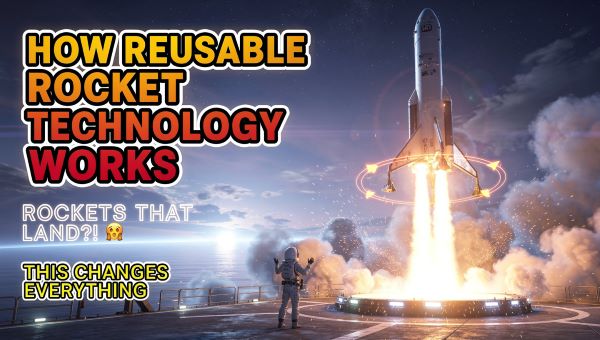
How Reusable Rocket Technology Works (Simple Guide)
How reusable rocket technology works is one of the most fascinating questions in modern science and engineering. For decades, space missions followed a simple but costly rule—launch once and throw everything away. Rockets were used for just a few minutes and then destroyed forever.
But today, companies like SpaceX have changed the game completely. Rockets can now return safely to Earth and be reused again and again. Learn more about space missions from NASA and explore reusable rocket innovation by SpaceX.
This breakthrough is not just cool to watch—it’s transforming the entire space industry. It is making space travel cheaper, faster, and more accessible than ever before.
So how does this incredible technology actually work? And why is it so difficult to achieve? Let’s explore everything step by step in simple language.
how reusable rocket technology works
🚀 The Old Problem: Why Rockets Were So Expensive


Before reusable rockets, every launch followed the same pattern:
- Rockets lifted off powerfully
- Delivered payload into space
- Then the booster fell back and was destroyed
The most powerful and expensive part—the rocket booster—was only used for about 90 seconds.
💡 Imagine buying a car and throwing it away after one drive. Sounds crazy, right?
That’s exactly how the space industry worked for over 50 years. Because of this:
- Space missions were extremely expensive
- Only governments could afford launches
- Innovation was slow
This problem created a huge barrier to exploring space.
💡 The Big Idea: Reusable Rockets


The idea behind reusable rockets is simple but powerful:
👉 What if rockets could come back safely and be used again?
This is exactly what reusable rocket technology does.
Instead of letting the booster crash into the ocean, it returns to Earth and lands vertically—ready for another mission.
The Falcon 9 is one of the best examples of this innovation.
🧩 How Reusable Rocket Technology Works (Step-by-Step)
Understanding how reusable rocket technology works becomes easier when we break it into simple steps.
🔄 Step 1: The Rocket Flip


After the rocket separates from the upper stage, the booster is moving at extremely high speed.
To return, it performs a mid-air flip so that its engines face downward.
👉 This maneuver is incredibly complex because:
- The rocket is moving thousands of km/h
- There is almost no air resistance in space
- Timing must be perfect
🔥 Step 2: Boostback Burn
The booster fires its engines again—this time in reverse direction.
This process:
- Slows down the rocket
- Changes its direction
- Sends it back toward the landing site
This is known as the boostback burn.
🌡️ Step 3: Surviving Re-entry


As the booster re-enters Earth’s atmosphere, it faces extreme heat and pressure.
To survive this phase, it:
- Fires engines to slow down
- Creates a protective layer of exhaust gases
- Reduces heat damage
Without this step, the rocket would burn up completely.
🧭 Step 4: Steering with Grid Fins


Now the rocket is falling back toward Earth.
To control its direction, it uses grid fins—small wing-like structures.
These fins:
- Adjust the rocket’s path
- Stabilize its movement
- Guide it toward the landing zone
All of this is controlled by onboard computers and GPS systems.
🛬 Step 5: Final Landing


This is the most critical moment.
Just seconds before touching the ground:
- The rocket fires one engine
- Slows down precisely
- Deploys landing legs
- Lands vertically
✔ No crash
✔ No explosion
✔ Just a perfect landing
😳 Why Reusable Rockets Are So Difficult
Reusable rockets may look smooth in videos, but the reality is extremely challenging.
Here’s why:
- Engines must restart in mid-air
- Speed must be controlled perfectly
- Extreme heat must be handled
- Timing must be flawless
Even a tiny error can cause complete failure.
That’s why early tests often ended in explosions. But each failure helped engineers improve the system.
- Launch 🚀
- Flip 🔄
- Boostback Burn 🔥
- Re-entry 🌡️
- Landing 🛬
👉 This visual helps readers quickly understand the entire process.
📋 Comparison Table: Old vs Reusable Rockets
| Feature | Traditional Rockets | Reusable Rockets |
|---|---|---|
| Usage | One-time use | Multiple launches |
| Cost | Very high | Much lower |
| Efficiency | Low | High |
| Innovation | Slow | Rapid |
| Environmental Impact | More waste | Less waste |
💡 Benefits of Reusable Rockets
Reusable rockets are not just a cool idea—they bring real-world advantages.
✅ Major Benefits:
- Lower launch costs
- More frequent missions
- Better satellite access
- Global internet expansion
- Faster innovation in space tech
This is why reusable rockets benefits are so important for the future.
🌍 Impact on the Space Industry
Reusable rockets are reshaping the entire space ecosystem.
Because of this technology:
- Private companies can enter space
- Startups can launch satellites
- Internet coverage improves globally
- Space tourism becomes possible
The future of space travel technology is now more exciting than ever.
🔮 The Future of Reusable Rocket Technology


The journey has just begun.
Companies are now working on:
- Fully reusable rockets
- Faster turnaround times
- Bigger and more powerful systems
Soon, rockets may operate like airplanes—launching and landing regularly.
🧠 Conclusion
Reusable rockets have completely transformed space exploration.
What once seemed impossible is now becoming routine. Thanks to innovations by companies like SpaceX, rockets no longer have to be disposable.
Instead, they can return safely, reducing costs and opening new opportunities for humanity.
👉 How reusable rocket technology works is not just a technical topic—it’s a glimpse into the future of human civilization.
Next time you watch a rocket launch, don’t just look up…
👀 Watch it come back.
More Read :