
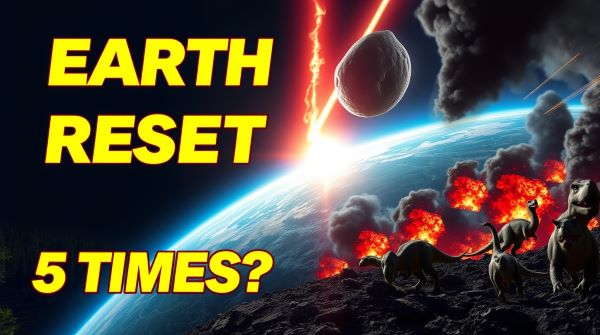
Five Mass Extinctions Explained in Simple Way
The five mass extinctions explained in simple way help us understand how life on Earth has changed over millions of years. Our planet has not always been safe for living beings. In fact, there were times when most life forms disappeared completely.
Scientists believe that Earth has faced five major extinction events, where a large number of species died in a short time. These events reshaped life and allowed new species to evolve.
In this blog, we will explore each extinction in a simple and engaging way so that even beginners can understand.
📊 What is a Mass Extinction?
A mass extinction is a period when a huge number of species disappear from Earth in a relatively short time.
Key Features:
- Happens globally
- Affects both land and ocean life
- Caused by natural disasters or climate changes
🧊 1. Ordovician–Silurian Extinction (444 Million Years Ago)
This is one of the earliest extinction events in the earth extinction timeline explained by scientists.
What Happened?
- Earth experienced a severe ice age
- Huge glaciers formed
- Sea levels dropped drastically
Impact:
- Most life existed in oceans, so marine life suffered the most
- Around 85% of species went extinct
Main Cause:
- Climate change due to continental movement
🌳 2. Late Devonian Extinction (360 Million Years Ago)
This period saw the rise of the first forests.
What Happened?
- Trees absorbed large amounts of carbon dioxide
- Nutrients flowed into oceans
- Massive algae blooms formed
Impact:
- Oxygen levels in oceans dropped
- Marine animals suffocated
Result:
- About 75% of species disappeared
This is a key example when studying the causes of mass extinction events.
🌋 3. Permian–Triassic Extinction (The Great Dying)
This was the biggest extinction in earth history.
What Happened?
- Massive volcanic eruptions in Siberia
- Release of greenhouse gases like CO₂ and methane
Effects:
- Global temperatures increased
- Oceans lost oxygen
- Ecosystems collapsed
Result:
- 90–96% marine life died
- 70% land animals went extinct
This event is often called “The Great Dying.”
🦖 4. Triassic–Jurassic Extinction (200 Million Years Ago)
This extinction paved the way for dinosaurs.
What Happened?
- Supercontinent Pangaea began breaking apart
- Massive volcanic eruptions occurred
Impact:
- Climate became unstable
- Many species could not adapt
Result:
- Around 75% of species disappeared
Interesting Fact:
This event helped dinosaurs become dominant on Earth.
☄️ 5. Cretaceous–Paleogene Extinction (66 Million Years Ago)
This is the most famous extinction event and explains how dinosaurs went extinct facts.
What Happened?
- A massive asteroid hit Earth
- Impact site: Present-day Mexico
Effects:
- Global wildfires
- Huge tsunamis
- Dust blocked sunlight
Result:
- Around 75% of all species died
- Dinosaurs became extinct
📊 Comparison Table of Mass Extinctions
| Extinction Event | Time (Million Years Ago) | Main Cause | Species Lost |
|---|---|---|---|
| Ordovician | 444 | Ice Age | 85% |
| Devonian | 360 | Ocean Oxygen Loss | 75% |
| Permian | 250 | Volcanoes | 90–96% |
| Triassic | 200 | Volcanic Activity | 75% |
| Cretaceous | 66 | Asteroid Impact | 75% |
🔬 What Can We Learn From These Extinctions?
Studying these events helps scientists understand:
- Climate change patterns
- Evolution of life
- Risks to modern ecosystems
Many researchers believe we might be entering a sixth mass extinction due to human activities.
❓ FAQs About Mass Extinctions
1. What is a mass extinction in simple terms?
A mass extinction is a period when a large number of species on Earth die out in a relatively short time. It affects life globally, both in oceans and on land. These events are usually caused by major changes like climate shifts, volcanic eruptions, or asteroid impacts.
2. What caused the five mass extinctions?
The causes of mass extinction events were different each time, but most were linked to natural disasters or environmental changes, such as:
- Extreme climate change (ice ages or global warming)
- Massive volcanic eruptions
- Ocean oxygen loss
- Asteroid impacts
Each event had unique triggers, but all disrupted ecosystems worldwide.
3. Which was the biggest extinction in Earth’s history?
The Permian–Triassic extinction, also known as the Great Dying, was the most severe. It wiped out about 90–96% of marine life and around 70% of land animals. Scientists believe massive volcanic eruptions caused extreme global warming and oxygen loss in oceans.
4. How did dinosaurs go extinct?
Dinosaurs went extinct during the Cretaceous–Paleogene extinction about 66 million years ago. A massive asteroid hit Earth, causing fires, earthquakes, and blocking sunlight with dust. This stopped plant growth, collapsed food chains, and led to the extinction of about 75% of all species, including dinosaurs.
5. Are we heading toward another mass extinction?
Many scientists believe we may be entering a sixth mass extinction due to human activities. Factors like climate change, deforestation, pollution, and habitat loss are putting many species at risk. However, with awareness and action, it may still be possible to slow or prevent it.
🧠 Conclusion
The five mass extinctions explained in simple way show how fragile life on Earth can be. Each event was caused by powerful natural forces like climate change, volcanic eruptions, and asteroid impacts.
But these disasters also created opportunities for new life to grow and evolve.
👉 Understanding the past helps us protect the future.
If we learn from these events, we can take better care of our planet and avoid another major extinction.