
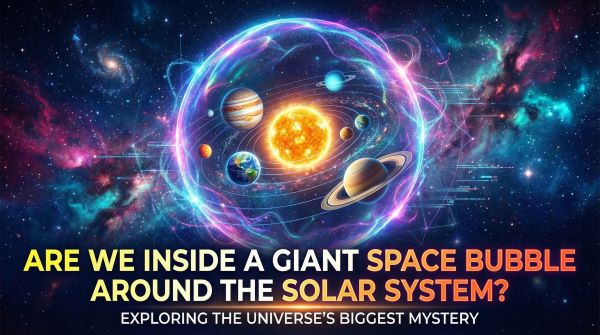
Are We Inside a Giant Space Bubble Around the Solar System?
# Introduction
For many years, we believed the Solar System was a well-understood part of our galaxy. We knew the planets, studied comets, sent probes to the edges of space, and even brought samples from asteroids back to Earth. But recent research has revealed something truly surprising: giant space bubble around the solar system, but *two enormous bubbles*.
This idea may sound like science fiction, but it is supported by real data from the Voyager spacecraft and detailed 3D modeling by astronomers. These cosmic bubbles protect us, shape our view of the night sky, and even influence how life survives on Earth. In this blog, we explore how these bubbles formed, what they do, and why the discovery of a giant space bubble around the solar system is one of the most fascinating findings in modern astronomy.
# ## What Did Voyager Discover at the Edge of the Solar System?
In 1977, NASA launched Voyager 1 and Voyager 2, two spacecraft designed to explore the outer planets and then travel beyond them. Decades later, both missions reached the outer boundary of the Solar System, a region called the heliopause.
# What is the Heliopause?
The heliopause is where the solar wind — a stream of charged particles flowing outward from the Sun — becomes so weak that it can no longer push against interstellar particles.
# Why Was Voyager’s Finding So Strange?
As Voyager moved beyond the heliopause, scientists expected the density of particles in interstellar space to match their calculations. Instead:
* At the boundary, density was lower.
* A short distance farther out, the density increased sharply.
This unexpected rise in density puzzled researchers. However, the explanation turned out to be simple: at the edge of the Solar System, solar plasma meets interstellar plasma, creating a “traffic jam” of particles. This region marks the boundary of the heliosphere, a smaller bubble created by the Sun.
## Understanding the Heliosphere: Our First Protective Bubble
The heliosphere explained is actually quite simple. It is a massive bubble made of solar wind. Everything inside it — the Sun, planets, moons, and asteroids — is protected from harmful cosmic radiation coming from the galaxy.
### Key Functions of the Heliosphere:
* Shields Earth from high-energy cosmic rays
* Helps maintain stable conditions for life
* Forms a natural protective barrier around the Solar System
Inside the heliosphere, particle density is relatively low. Outside it, interstellar space behaves differently, leading Voyager to detect unexpected changes.
# The Much Bigger Bubble: Introducing the Local Bubble
While the heliosphere surrounds only the Solar System, astronomers found something far larger: the Local Bubble in space, a huge cavity in the Milky Way measuring about 1000 light years across.
This was discovered using advanced computer simulations and data from the European Space Agency’s Gaia observatory.
## How Did the Local Bubble Form?
Around 14 million years ago, a series of about 15 massive stars exploded as supernovae. These violent explosions:
* Pushed surrounding interstellar gas outward
* Created a hollow, bubble-like structure
* Formed dense walls around the bubble where new stars could emerge
The shockwaves cleared out dust and gas inside the bubble, leaving behind a huge, relatively empty region.
# ## Where Is the Sun Inside This Giant Bubble?
Interestingly, the Sun was not originally at the center of the Local Bubble. When the supernova explosions occurred, the Sun was far away. But as it traveled through the Milky Way, it drifted into the bubble and is now positioned almost exactly in the center.
This alignment might be more than a coincidence. Some studies suggest that when the Sun passes through denser regions of the galaxy, mass extinctions on Earth become more likely. Today, being inside this bubble may be one reason our planet experiences relatively calm cosmic conditions.
# ## How the Local Bubble Shapes Our View of the Universe
The Local Bubble influences more than just particle density — it changes how we see the night sky.
### Because the Local Bubble is nearly empty:
* Starlight travels to us with less obstruction
* The sky appears brighter and clearer
* We can observe distant stars more easily
If the Solar System were inside a dense cloud of gas and dust, much of the sky would be blocked. Our understanding of space might be very different.
# ## The Solar System’s Full Structure Inside the Bubbles
To understand the placement of the Solar System within the bubbles, here is a simplified structure:
* Sun at the center
* Planets out to Neptune at 30 AU
* Kuiper Belt extending to about 55 AU
* Heliopause at around 120–130 AU
* Oort Cloud stretching up to 1.5 light years
* Entire system surrounded by the Local Bubble
This layered structure shows how our Solar System floats inside nested protective zones.
# ## Why These Cosmic Bubbles Matter to Us
These bubbles are not just interesting; they play a crucial role in our safety.
### 1. Protection from Cosmic Radiation
Without the heliosphere, Earth would be exposed to dangerous particles that could disrupt life.
### 2. Stable Galactic Environment
The Local Bubble reduces the amount of interstellar dust and debris near the Solar System.
### 3. Cleaner Path for Future Space Travel
Dust particles in space can damage spacecraft moving at high speeds. The Local Bubble’s low dust density makes it a safer region for potential interstellar missions.
# ## Conclusion
The discovery of a giant space bubble around the solar system has changed how we imagine our place in the Milky Way. Far from drifting alone, we are protected by two enormous cosmic structures — one created by the Sun, and another shaped by ancient exploding stars. These bubbles influence the environment around Earth, protect life, and even give us a clear view of the night sky.
Understanding these discoveries helps us appreciate how dynamic and interconnected our galaxy truly is. As science continues to explore these structures, one thing becomes clear: our cosmic neighborhood is far more fascinating than we ever imagined.
If you enjoyed this article, stay connected for more simple, beginner-friendly explanations of the universe!