
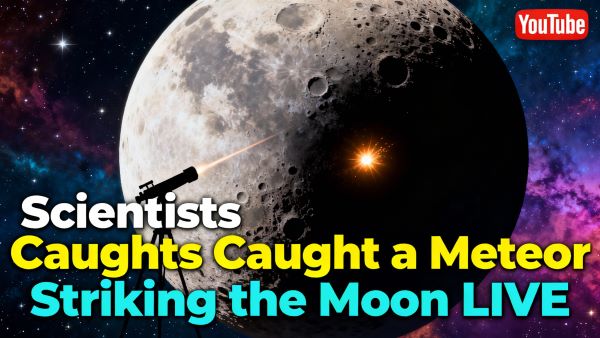
Moon Impact Caught Live from Earth: Rare Lunar Flash Explained
Moon impact caught live from Earth is not something we hear about every day. Earlier this month, astronomers witnessed a rare and fascinating event — a brief flash of light on the Moon caused by a small space object crashing into its surface at extreme speed. What made this event special was that it was seen in real time, not discovered later in recordings.
This moment offered scientists a rare opportunity to directly observe how space debris interacts with the Moon. It also gave us new insights into meteor activity, especially its connection to the Geminid meteor shower. In this blog, we will break down what happened, why it matters scientifically, and what it tells us about ongoing activity around the Moon — all in simple, easy-to-understand language.
🌠 What Does “Moon Impact Caught Live from Earth” Mean?
A moon impact caught live from Earth refers to a meteor or small space rock hitting the Moon, with the collision being observed instantly through a telescope on Earth.
Normally, such impacts are:
- Found later during video analysis
- Detected by automated software
- Missed entirely due to their short duration
In this case, the observer noticed the flash as it happened, making it an extremely rare and valuable observation.
🕒 When and Where Did the Lunar Impact Occur?
The impact happened on December 12, 2025, at 03:09 UTC.
Key details:
- The flash lasted less than one second
- It appeared on the dark side of the Moon
- Observed using a robotic ground-based telescope
- Likely located near the Langrenus crater
Because the Moon was in a new moon phase, sunlight was not reflecting off the surface. This darkness allowed the brief flash to stand out clearly.
🌑 Why Lunar Impacts Are Easier to See on the Dark Side
The Moon reflects sunlight very strongly. When impacts occur on the sunlit side, they are almost impossible to detect from Earth.
On the dark side:
- There is no sunlight interference
- Even a tiny flash becomes visible
- Detection chances increase significantly
That’s why lunar monitoring programs focus heavily on observing the Moon during darker phases.
☄️ How Big Was the Object That Hit the Moon?
The object responsible for the impact was very small, likely only a few centimeters across.
However, size isn’t the most important factor here — speed is.
Estimated impact speed:
-
Around 35 kilometers per second
At such extreme velocities:
- Even a pebble-sized object carries massive energy
- The impact instantly converts energy into heat and light
- This creates the visible flash observed from Earth
🔬 Why Lunar Impact Flashes Matter to Science
Unlike Earth, the Moon has no atmosphere. That means:
- No air resistance
- No burning up of incoming objects
- Direct, unfiltered impacts
This makes the Moon a natural laboratory for studying space collisions.
Scientists can learn:
- How often small objects hit the Moon
- The energy released during impacts
- The size and speed of meteoroids
- The behavior of near-Earth space debris
Each observed flash helps improve models of the space environment around Earth.
🌠 Connection to the Geminid Meteor Shower
This lunar impact happened during the Geminid meteor shower, which occurs every December and is one of the most active meteor showers of the year.
Why the Geminids are special:
- They come from 3200 Phaethon
- Phaethon behaves like an asteroid, not a comet
- It releases rocky debris when close to the Sun
When Earth passes through this debris:
-
We see bright Geminid meteors in the sky
But Earth is not the only body crossing this debris stream.
🌕 Does the Moon Also Pass Through Meteor Streams?
Yes, it does.
The Moon regularly travels through the same regions of space as Earth. This means:
- It encounters the same debris particles
- Meteors that burn up on Earth can strike the Moon directly
The estimated impact speed and timing strongly suggest this event was linked to the Geminid meteor stream.
📍 Why This Observation Is Rare
This event was:
- The first confirmed lunar impact flash recorded from Ireland
- Only the second recorded from the British Isles
Considering:
- The Moon’s vast surface
- The extremely short duration of flashes
- Limited monitoring coverage
Such detections are still uncommon and highly valuable.
🚀 Why Lunar Impacts Matter for Future Moon Missions
Interest in long-term lunar exploration is growing rapidly.
Planned missions include:
- Scientific instruments
- Communication systems
- Human habitats
Even small impacts can:
- Damage exposed equipment
- Degrade surfaces over time
- Pose long-term risks
Understanding impact frequency helps engineers design better protection systems for future lunar infrastructure.
👁️ The Future of Lunar Impact Monitoring
Thanks to advances in:
- High-speed cameras
- Automated detection software
- Global telescope networks
Real-time lunar impact detection is becoming more practical.
In some cases, spacecraft orbiting the Moon may even:
- Capture images of fresh impact craters
- Confirm ground-based observations
Even when no crater is visible, the data remains scientifically useful.
🌌 What This Event Tells Us About the Moon
This brief flash reminds us that the Moon is not inactive or “dead.”
Instead, it is:
- Constantly interacting with space debris
- Continuously shaped by small impacts
- A key record of solar system activity
Each impact is a natural experiment that helps scientists understand planetary surfaces and space environments better.
✅ Conclusion: Why This Moon Impact Matters
The moon impact caught live from Earth was more than just a quick flash. It was direct evidence of ongoing space activity happening right next door to our planet.
Key takeaways:
- Small objects hit the Moon more often than we realize
- Meteor showers affect both Earth and the Moon
- Real-time observations improve space science
- This knowledge supports future lunar exploration
As monitoring technology improves, such events will become less rare — and far more valuable.
👉 If you’re fascinated by space science, keep watching the Moon. It’s more active than it looks.